

The Guardrails Were Us
REWIRING THE REPUBLIC · THE FOREWORD | Why I am writing this series, and why now: the repairs are not optional, and it has been done before—in worse weather than this.

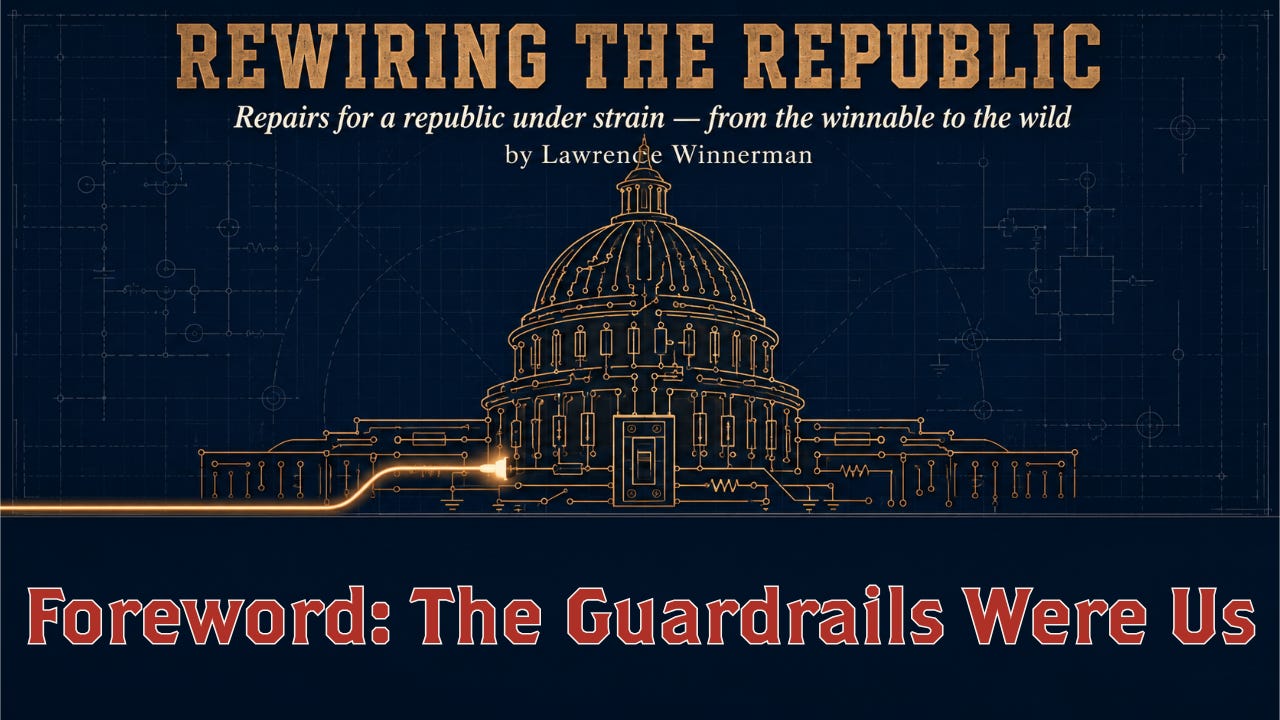
by Lawrence Winnerman
In the last week of January 2025, 17 inspectors general—the federal government’s internal watchdogs, the people whose entire job is catching fraud and abuse inside the agencies they oversee—were fired in a single night, most of them by a two-line email. Federal law is not ambiguous about this. It requires 30 days’ advance notice to Congress, in writing, with case-specific reasons, before an inspector general can be removed.
No notice was given. No reasons either.
Nothing happened. Some letters were sent. Some statements expressed concern. The law requiring the notice was still on the books the next morning, unrepealed, fully in force, and fully irrelevant.
It had simply stopped being important, because the truth was that there was never an enforcement mechanism in place.
What the Guardrails Were Made Of
For most of my life I believed—because I was taught, carefully and well, by people who believed it themselves—that American democracy was a machine full of guardrails. Checks and balances, presented to a kid in the 1970s as something close to physics. Watergate was the proof in my childhood: the system worked, we were told, because a president who broke the law was made to leave. It did not occur to me until embarrassingly recently that the sentence had a quieter second half. The system worked because that president’s own party decided it should. Because senators walked up the drive and told him it was over. Because he agreed to go.
The last decade has been a public stress test of every assumption in that civics lesson, and the second presidential term we are now living through has finished the demolition. One by one, the things we called guardrails have turned out to be made of something softer than we thought: norms. Customs. Gentlemen’s agreements between people who stopped being gentle some time ago. The 30-day notice. The income tax releases. The recusal. The blind trust. The precedent. The way it’s always been done. Each of them held for decades—not because anything enforced them, but because everyone agreed to behave as if they were walls.
A guardrail that depends on the driver’s goodwill is not a guardrail. It is a suggestion painted on the road.
The guardrails were us. They were only ever us.
That sentence can land two ways, and the entire posture of this series depends on which one you choose. It can land as despair: Nothing was ever protecting us. Or it can land as assignment: We were the enforcement element all along, and that responsibility has not gone anywhere. I choose the second reading, and not out of temperament. Out of history.
The House We Inherited
The Constitution of 1787 is a house—a genuinely brilliant house, designed by people who had just escaped a landlord and thought hard about doors and locks. And its wiring was state of the art for the eighteenth century: information moving at the speed of a horse, power flowing through institutions designed to be slow on purpose, because slowness was the safety feature.
We still live in that house. We have added rooms—27 amendments’ worth. We have swapped fixtures by statute a thousand times. But the core wiring is original, and the load has changed. The house was wired for candles, and we are running data centers on it. Decisions that the founders assumed would take a season now happen in an afternoon; the president’s hand rests on switches the framers never imagined one hand would reach; information—true and false—moves through the walls at a speed no breaker in the original design can trip. I have written elsewhere in this publication about what happens when democratic institutions meet machine speed. This series is about the wiring itself.
And the maintenance is overdue in a way we have stopped noticing. The last constitutional amendment conceived and ratified by living Americans was the Twenty-Sixth, in 1971. (The Twenty-Seventh, ratified in 1992, was a leftover proposed in 1789—a curiosity, not a repair.) If you are younger than 73, the Constitution has never been freshly amended in your adult lifetime. We treat that as normal. It is not normal. It is deferred maintenance on a 239-year-old electrical system, and deferred maintenance does not stay deferred. It compounds. The shorted circuit takes the wall with it.
It Has Been Done Before
Now the part the doom headlines never include.
Americans have rewired this house before—repeatedly, structurally, and almost never in calm weather. The Progressive Era put four amendments into the Constitution in eight years, including two that fundamentally redistributed power: the direct election of senators and the income tax. Women won the vote by amendment in 1920 after 70 years of organizing. And between 1961 and 1971—one decade—Americans amended the Constitution four separate times: presidential votes for the District of Columbia, the abolition of the poll tax, presidential succession, and the vote for 18-year-olds. That last one, the Twenty-Sixth, went from congressional proposal to full ratification in about a hundred days. The fastest constitutional surgery in American history was performed in 1971.
The country that did that: Vietnam at full boil. Cities that had burned two summers running. A president the other party loathed. Assassinations still fresh in the national memory, a generation in open revolt against its parents, and a political establishment certain the republic was coming apart. Those Americans—frightened, furious, divided in ways we would recognize instantly—looked at the house and rewired it anyway. Four times.
They were not better than us. They were not calmer than us. They were just earlier.
And now the honest other half, because this series does not deal in pep talks. It is also true that the amendment path is harder today than it has ever been. Ratification takes 38 states, and we have sorted ourselves into a country where 13 legislatures can block anything, and reliably would. The parties have nationalized; the muscle has atrophied from 50 years of disuse; and the same fraught, contentious moment that makes the repairs urgent makes the biggest tools hardest to reach. Both of those things are true at once—it has been done before, and it may be harder now than ever.
This series lives in the space between those two sentences.
Not Optional
Which brings me to the quiet lie underneath most democracy writing: the word “optional.”
Reform as a preference, an enthusiasm, a genre for people who listen to podcasts about the Federalist Papers. Wouldn’t it be nice. Someday, maybe. And for a long time the lie was affordable, because the norms were holding and the house, however creaky, kept the lights on.
The norms are not holding. We have now watched—are watching, in real time, this year—what the house does under a tenant who probes every wall for what is actually load-bearing and what was only ever paint.
The answer, too often, has been paint.
That knowledge does not expire when any one tenant leaves. Every future occupant of every office now knows exactly which restraints were real. The 17 inspectors general are not an anecdote; they are the new baseline. What one president does without consequence, the next president starts from.
So no—rewiring is not optional, and it is not partisan, any more than a fire code is partisan. Some of these repairs are cheap and could pass this year. Some require rebuilding the service panel. A few require asking whether the house needs a second founding, and I will take even those seriously when we get there. But the choice on the table is not reform versus the status quo. There is no status quo. The wiring is failing at the pace of the loads we put on it. The choice is repair, or keep discovering—one shorted circuit at a time, one ignored statute at a time—what was never actually attached to anything.
Here is how we will do it. The series is built as a ladder—every repair American democracy needs, bundled and ordered from easiest to hardest. It starts with bills Congress could pass this fall with the members it already has. It ends at the hardest questions a constitutional democracy can ask itself. Every essay scores its reforms the same way, on the questions that actually matter: how much it fixes, how hard the lift, how long it takes, and what breaks it. You do not have to believe in the top of the ladder to climb the bottom of it. You just have to start climbing.
The Why
I am 56 years old. My generation got the tail end of the confident civics—the Bicentennial, the filmstrips, Schoolhouse Rock, the machine that fixes itself—and has spent its adulthood watching the machine not fix itself. We were told the wiring would outlast us. It will not, not without work, and I have stopped waiting for the electricians of legend to show up. There are no electricians coming. There is us, a stack of blueprints, and a house that is worth it.
The moment is precarious. The guardrails were us. The repairs are not optional. And people more frightened than we were did harder repairs than these, in worse weather than this.
The ones who rewired this house before us were not braver than we are.
They were just earlier.
It’s our turn at the panel.
Thanks for Reading!
I write The Hinge & Near Field as an independent writer—no staff, no sponsor, no institution behind me. If this essay was worth your time, the single best way to support the work is a paid subscription. It is the difference between writing like this existing and not.
If you think someone else should read it, restack it or share it. Word of mouth is how independent writing finds its readers, and every share reaches people I never could on my own.
And if it moved you, tell me. I read every comment, and I write back.
About the Author
Lawrence Winnerman is a science fiction novelist and essayist writing at the crossroads of culture, politics, and technology—chronicling how we live, create, and fight for meaning in an age of upheaval. He is the founder of Peptidings and COO of Blue Amp Media (with Cliff Schecter). After 25 years at Microsoft and Amazon, he now writes about what comes after the institutions break—in essays, near-future scenarios, and serialized science fiction—at his Substack, The Hinge & Near Field.
Find him at lawrencewinnerman.com, or leave a one-time tip on Ko-fi.


Lawrence, this was so well written. I'm old enough to have lived through the 1970's. I actually graduated college in 1971. You described the era perfectly. It was a time of great upheaval. I don't recall however the despair with Nixon as we do with Trump. Even though Nixon hurt the norms, he didn't destroy them. Trump is like a toddler smashing his toys because he's throwing a tantrum. Trump has earned a time out so we can start to repair the mess he's made. Then we have to figure out how to child proof the house. It's a huge task and I hope we are up to it. It looks like a second revolution (hopefully bloodless) is going to take place. One of building guardrails to fit the 21st century made of sturdier stuff than a gentleman's agreement. I think we are up to the task. You have laid it out well here and also injected hope.
So I just read this. Incredible. I’ve started reading a book on the civil war, and it’s crazy how those times parallel these. I’m worried about a second civil war. Your article gave me hope. Not Pollyanna wishful thinking. Concrete hope. Thank you.