



A NOTE ON THE NEAR FIELD
The Near Field is structured scenario fiction — plausible futures extrapolated from present forces. The Hinge essays examine structural drift in isolation. The Near Field shows what happens when those forces interact.
The characters in this piece include named political figures operating in a speculative future context. Their portrayal reflects the structural logic of the institutions they inhabit, not any claim about their private character or future conduct.
The incident described here has not happened.
The conditions that would produce it have.
OPENING
Strait of Hormuz. October 2029.
The strait is twenty-one miles wide at its narrowest point. Through it passes roughly one-fifth of the world’s traded oil. That number has not changed significantly in decades. What has changed is everything else.
The ceasefire framework signed in March of 2027 ended the formal hostilities of the Iran war. It did not end the Iran war. It produced, instead, a collapsed western corridor — competing factions, fractured authority, a humanitarian emergency that the international community described with great precision and addressed with moderate effort. By late 2029, the Persian Gulf coast holds several hundred thousand displaced Iranians in various stages of movement. Some travel through organized humanitarian channels. Some do not. The strait has become the most complicated maritime corridor on earth: commercial tankers waiting for clearance, U.S. naval assets running enforcement operations under an authorization framework that has not been formally renewed since 2027, and below the surface of all of it, a refugee crisis moving through the same water.
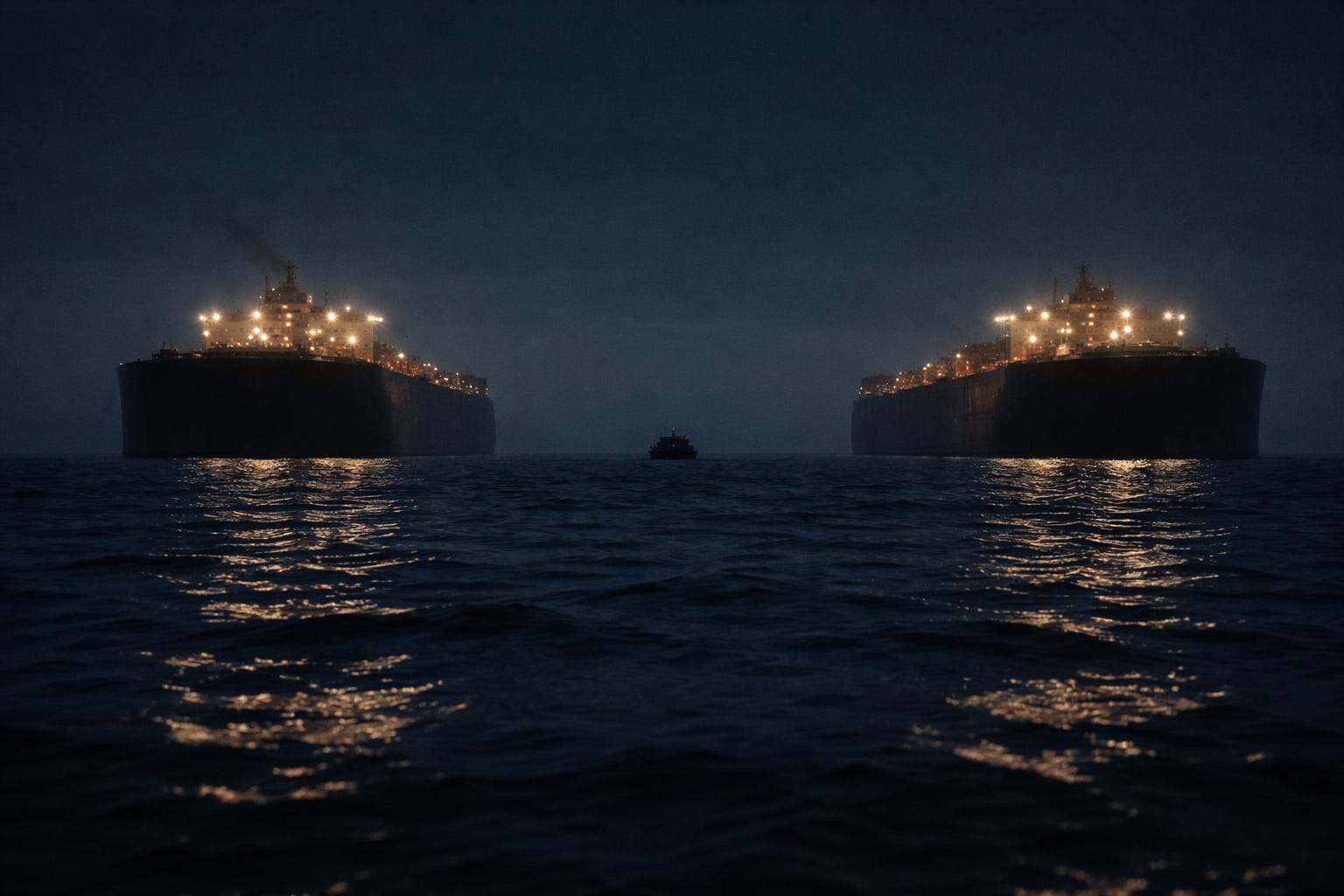
Six supertankers sit anchored in the northern passage, waiting. They have been waiting for four days. The clearance process takes longer now. Everything takes longer now.
A loose formation of four humanitarian vessels moves slowly south through the corridor. The largest, a converted cargo ship called Al-Salam IV, carries three hundred and forty people. It has been at sea for six days. Its captain has been navigating around military assets with the practiced anxiety of someone who has learned, through experience, that proximity to power does not mean protection from it.
Somewhere in the dark between the supertankers, a vessel runs without lights. It moves with the particular efficiency of people who know exactly where they are going and have reasons for not being seen.
The Israeli operation had no name that would ever appear in an American system.
The American targeting system had been updated with new maritime behavioral models in August. The contractor had noted, in a technical appendix filed with the Department of Defense, that accuracy in post-conflict corridors with mixed civilian and military traffic remained a known limitation pending additional training data.
The operational framework governing the system’s deployment had been approved by the previous administration. The current administration had adopted it.
The system was running.
REUTERS | October 14, 2029 Newsom administration defends continued Gulf operations under 2027 framework; White House says “no new authorization required”
POLITICO | October 15, 2029 AOC war powers select committee hits wall — Republican Senate refuses witness subpoenas for third consecutive month
FOX NEWS DIGITAL | October 16, 2029 Day 11: Families of American hostages demand action as White House stays silent on Gulf standoff
WALL STREET JOURNAL | October 16, 2029 Gulf tanker convoy delay enters fourth week; shipping insurers raise Iran corridor premiums by 34%
I. NASRIN
Al-Salam IV. Northern Strait of Hormuz. October 17, 2029. 03:40 local time.
Nasrin Moradi is on deck because she cannot sleep.
This is not unusual. She has not slept well since Ahvaz, and Ahvaz has been two years ago now, and still the sleep does not come the way it used to. Below, Shirin is in her bunk — eight years old and capable of sleeping through anything, which Nasrin has decided is a gift, one of the only unambiguous gifts the last two years have produced. Her mother Maryam is below as well, though Maryam also sleeps poorly, and Nasrin has left her pretending so that neither of them has to pretend together.
She stands at the rail and looks north at the tankers.
There are six of them, anchored in a loose formation a half-kilometer out. They are lit up like small cities. They have been there since the ship arrived in the corridor two days ago, waiting for the clearance that keeps not coming, and in a strange way Nasrin has come to find them reassuring. Large. Stationary. Proof that commerce is still functioning, even if slowly. Proof that someone has calculated that this water is worth crossing.
She thinks about her pharmacy.
It was on the corner of Imam Khomeini Boulevard, not far from the university. A good location. She had worked there for eight years before she owned it, and then owned it for three years before the fighting made the question of ownership irrelevant. She thinks about the particular smell of it — the sharp antiseptic underneath, the softer smell of the soaps and cosmetics on the front shelves, the way afternoon light came through the western window and made the orange pill bottles glow. She thinks about these things the way she has learned to think about them: steadily, without pushing, the way you carry something fragile.
Her mother taught school for thirty years. Retired the year before the war. Had plans. Had a garden. Was afraid of the water and came onto this boat anyway because Nasrin told her it was safer than the land route, and her mother had looked at her the way mothers look at their children when they are deciding whether to believe them.
The tankers hum faintly across the water. Somewhere below, someone coughs. The ship smells of too many people and salt and diesel and the faint sweetness of the food someone cooked hours ago.
She is watching the tankers when she sees it.
A vessel, moving between them. Small. Fast. Running dark — no lights, no navigation signal, nothing. It threads the gap between the second and third tanker with a precision that has nothing accidental about it. She watches it for perhaps thirty seconds before it disappears behind the bulk of the third tanker and does not reappear.
She stands at the rail for a while longer.
She does not know what she saw. She has no framework for it. She files it in the same category as the other things she has seen in the past two years that she did not have frameworks for: something happened, something with a logic she cannot access, and the only reasonable response is to note it and continue.
She goes below. She checks that Shirin is covered — she has kicked the blanket to the foot of the bunk in that way she has, the same way since she was three years old. Nasrin covers her. She lies down next to her mother, who is lying very still in the way of someone trying not to be awake.
She does not sleep.
AP | October 17, 2029 — 06:15 EST U.S. military confirms “active monitoring” of Gulf corridor situation; no further comment
CNN | October 17, 2029 — 07:44 EST Sources: White House convened National Security Council early this morning; topic undisclosed
II. CHEN
USS Decatur. Combat Information Center. Northern Gulf. October 17, 2029. 14:22 local time.
Commander Sarah Chen has been on watch for six hours.
The targeting package for the vessel designated SIERRA-7 has been in front of her for ninety minutes. She has read it three times. She is the kind of officer who reads things three times and knows, by the third reading, whether she has fully understood them or whether she is reading for confirmation of what she has already decided. This is the third reading. She is not entirely sure which kind it is.
The AI confidence score is 94%.
The package is clean. Signal intercepts consistent with faction command-and-control architecture. Movement pattern correlated with two independent human intelligence reports placing the faction’s logistics coordinator aboard the vessel within the last seventy-two hours. Behavioral analysis flagging communication patterns consistent with an active operational node — the kind of node that, taken dark, creates the opening the extraction team needs.
The hostages have been held for eleven days.
She pulls up the note from analyst Marcus Webb one more time. Filed seventy-one hours ago. Webb had flagged anomalous movement patterns in the vessels adjacent to SIERRA-7 — specifically an approach-and-contact sequence that did not match commercial traffic behavior and was not consistent with the refugee vessels operating in the corridor. Webb had written, in the careful hedged language of someone who knows he is speculating: movement profile possibly consistent with special forces insertion, third-party origin unknown. Recommend 48-hour hold pending clarification with allied commands.
The system had weighed Webb’s note against the preponderance of evidence and classified it as inconclusive. Below the threshold for operational delay. The confidence score remained 94%.
Chen has looked at Webb’s underlying data. He is right that something moved oddly. He is also right that it could be a dozen things — commercial traffic, a refugee vessel sheltering near the tankers, a fishing boat running the corridor after dark. His note is a flag, not a finding. The confidence score is 94%. The operational window closes in four minutes. The extraction team is staged. The hostage families have been on television for eleven days.
She reads the note one more time.
In the last two seconds before she approves — not the twenty-three seconds, but the last two, the actual moment — she has a feeling. She would not call it doubt exactly. It is quieter than doubt. It is more like the sensation of a door that is not quite level in its frame: nothing is wrong, structurally, and yet the hang of it is slightly off. She has had this feeling before, across fourteen years of service, and she has learned to take it seriously and she has also learned that taking it seriously means asking whether the feeling is data or whether it is noise.
The confidence score is 94%. The system has cleared eleven operations above 92% without incident. The window is closing.
She approves.
Twenty-three seconds.
The authorization transmits. The targeting system acknowledges. Chen turns back to the broader tactical display, already watching the next quadrant, the next variable, the long professional habit of moving forward.
The feeling does not go away. She notes that and moves forward anyway.
BREAKING — AP | October 17, 2029 — 14:38 local / 06:38 EST Explosion reported in northern Strait of Hormuz; U.S. military confirms “operational activity in the area”
BREAKING — REUTERS | October 17, 2029 — 07:02 EST Multiple explosions near tanker convoy in Hormuz Strait; cause unknown; tanker traffic halting
BREAKING — BBC | October 17, 2029 — 07:19 EST Massive fire visible from Omani coast; at least two supertankers ablaze; Strait of Hormuz passage status unknown
BREAKING — AL JAZEERA | October 17, 2029 — 07:31 EST Humanitarian convoy in proximity to Hormuz explosions; communication lost with vessel Al-Salam IV; 340 civilians aboard
III. NEWSOM
Situation Room. The White House. October 17, 2029. 07:44 EST.
The screens update faster than anyone in the room can speak.
Gavin Newsom has been here for ninety minutes, and in those ninety minutes he has watched the damage assessment assemble itself in layers, each one worse than the last, with the particular quality of catastrophes that are still becoming what they are going to be. Three supertankers. The strait effectively closed. The debris field still spreading. The extraction team that had been staged for the hostage operation — staged, waiting for the command node to go dark — reporting that they cannot reach the secondary vessel. Cannot reach it because the secondary vessel is inside the blast radius.
The hostages.
The hostages are dead.
Derek Salazar, his National Security Advisor, is walking him through the cascade: thermal event from the primary vessel reaching the adjacent supertanker, the fuel stores, the chain of it, three tankers burning in the narrowest navigable passage in the world. Oil prices spiking in pre-market trading. The Gulf states on the line. The Israeli Prime Minister’s office on hold.
Newsom says: Put the Prime Minister through.
The call is controlled and furious and conducted in the careful language of two governments that have stopped fully trusting each other and have not yet decided how to say so publicly. The Israeli side does not say everything it needs to say on this line. What it communicates, in the deliberate ellipses of diplomatic crisis, is enough.
There were Israeli forces on that vessel.
Newsom’s chief of staff, Andrea Okafor, is watching him. Salazar is watching him. Four other people in the room are watching him with the particular stillness of people who have just understood the full shape of something.
He tells the Prime Minister that the United States will provide a full accounting.
He hangs up.
The room is quiet in the way that rooms are quiet when everyone is waiting for the person with the most to lose to speak first.
He asks, very calmly: Did anyone in this building know there was an Israeli operation on that vessel?
The answers, when assembled from the careful non-answers that professionals give when they are protecting themselves and their institution simultaneously, amount to this: there was an intelligence note. Filed by an analyst. Seventy-one hours before the strike. It was in the system. It was classified as inconclusive.
Newsom asks: Did the system account for it?
Salazar says: The system weighted it below the operational threshold.
And who decided what the threshold was?
Nobody answers immediately.
Because the answer is: the system. And the system was built by a contractor. And the contractor’s deployment parameters were set by the previous administration’s NSC framework. And this administration adopted that framework — intact, unreviewed, because reviewing it would have required a process that nobody had the political bandwidth for, and the system had performed within parameters on eleven previous operations, and the operational need in the corridor was real and urgent and the framework was already there.
How many people on the humanitarian vessel?
Salazar checks. He looks up. Still unclear. Estimates between one-forty and one-eighty.
Iranian?
Mostly.
Newsom looks at the screens for a while.
He has authorized military operations before. This is not his first time in this room with bad outcomes assembling themselves on screens. He knows the weight of it and he does not romanticize the weight of it, because romanticizing it is a way of not fully feeling it, and he has always thought that not fully feeling it is a trap.
He feels it now.
What he also feels — and this is the thing he cannot say in this room, cannot say to Okafor, cannot say to Salazar, will not fully say to himself until much later — is the shape of the accountability void opening beneath him. He cannot explain the targeting decision without implicating the system. He cannot explain the system without implicating the framework. He cannot explain the framework without implicating his own adoption of it. He cannot discuss the Israeli dimension without a diplomatic rupture. He cannot tell the full truth about what the AI decided because the AI’s logic is not fully reconstructable in a form that a press conference can handle.
He cannot tell the full truth because the full truth requires explaining a decision that no human fully made.
How long until we need a statement?
His communications director says forty-five minutes.
He nods. He asks for a coffee. He looks at the screens. The fires are still burning on the satellite feed — orange and white against the dark water, remarkably beautiful from altitude, the way catastrophes often are.
Forty-five minutes.
NEW YORK TIMES | October 17, 2029 — 10:15 EST White House: U.S. military conducted “targeted, authorized operation” in Hormuz; investigation underway into tanker damage
WASHINGTON POST | October 17, 2029 — 10:44 EST Oil prices surge 40% in early trading as Hormuz closure confirmed; Goldman Sachs warns of “historic supply shock”
FOX NEWS DIGITAL | October 17, 2029 — 11:02 EST HOSTAGES DEAD: American aid workers killed in Hormuz explosion; White House silent on details
HAARETZ (ENGLISH EDITION) | October 17, 2029 — 18:30 local IDF silent on Hormuz incident; defense ministry sources describe “serious communication failure with U.S. command”
IV. PRESCOTT
Senate Majority Leader’s Office. U.S. Capitol. October 17, 2029. 11:30 EST.
Senator Dale Prescott of Missouri is on his fourth call of the morning, and the calls keep getting better.
His caucus is furious in the specific way that a political caucus is furious when an opponent has handed them something large and clean and undeniable. Three supertankers. The Strait closed. The hostages dead. A Democratic president who authorized an operation that has destabilized the global oil supply and cannot fully explain what he authorized or why the system made the decision it made.
Carolyn Voss, his chief of staff, has three draft response documents on the table in front of him. She has arranged them by escalation level. This is one of the things he values about her: she understands that the choice of weapon is as important as the decision to fight.
He reads through them with the focused attention of someone who has been doing this for twenty-three years and knows exactly what each option costs and what it buys.
Option one is the constitutionally serious move: a joint resolution demanding full disclosure, threatening to cut off operational funding pending an independent review of the AI targeting framework, and calling for the formal expiration of the 2027 authorization. It would do real structural damage. It would force a genuine reckoning with executive war authority.
He sets it aside.
He sets it aside because Senator James Whitfield of Texas is going to be the Republican presidential nominee in 2032, and Prescott has spent three years building the conditions for that nomination, and Whitfield is going to need the executive war authority that Newsom is currently holding. A framework that Prescott constrains in 2029 becomes the cage that Whitfield operates in from 2033. Prescott does not intend to build that cage. He intends to move into it.
Option two is the productive middle: a resolution expressing grave concern, demanding public accountability, calling for a select committee investigation with full subpoena power. Maximum noise. No actual structural consequence. The subpoenas run into litigation. The litigation runs eighteen months. The news cycle moves. The executive authority is untouched. Prescott gets to be outraged and responsible simultaneously, which is the only tone that plays in the current environment.
He taps option two.
Then he reads option three: joint press conference with Whitfield today, expressions of outrage, calls for accountability, a demand that Newsom appear before Congress, nothing specific about what accountability would actually look like.
He looks at Voss. Why did you give me three?
She says: Because you like having three.
He almost smiles.
Set up the press conference. Get Whitfield’s people on the phone. He stands, reaching for his jacket. What’s the humanitarian count?
Voss checks her tablet. Still unclear. The vessel they’re calling Al-Salam IV — somewhere between one-forty and one-eighty. Mostly Iranian.
Prescott nods slowly. Mostly Iranian. He turns the phrase over once, the way you test a floorboard before putting your full weight on it.
He picks up his prepared remarks. The humanitarian count doesn’t change the press conference. If anything, the Iranian civilian toll complicates the sympathetic framing — the American hostages are the story he can use. The Iranian civilians are the story that requires more careful management.
He is not a callous man. He has three children and he sat with his wife through her cancer treatment four years ago and he has cried at funerals. He knows that one hundred and forty or one hundred and eighty Iranian civilians dying in a humanitarian corridor is a tragedy of a particular kind — the kind where people had already lost nearly everything and lost the rest of it in the worst possible way.
He also knows that the political structure of this moment does not have a mechanism for that tragedy and his press conference. They live in separate registers. He operates in one of them.
He walks toward the door. Outside, the Capitol dome is bright in the late-morning sun.
Let’s go.
POLITICO | October 17, 2029 — 13:15 EST Prescott calls Hormuz incident “catastrophic failure of leadership”; demands Newsom appear before Senate
THE HILL | October 17, 2029 — 13:44 EST AOC war powers committee announces emergency session; Speaker says “serious constitutional questions must be answered”
CNN | October 17, 2029 — 14:20 EST White House pushes back on congressional pressure: “This is a time for unity, not political opportunism”
TWITTER / X | October 17, 2029 — trending #HormusCatastrophe · #GasPrice · #WhoApprovedThis · #AOCvsNewsom
V. AOC
Speaker’s Office. U.S. Capitol. October 17, 2029. 15:00 EST.
Alexandria Ocasio-Cortez has been on the phone with her caucus for three hours, and the calls have sorted themselves into categories with the grim efficiency of triage.
The first category: members who want her to go after Newsom hard. To use the moment. To make the structural argument she has been making for eighteen months in a setting where the public is finally paying attention.
The second category: members who are terrified that going after Newsom hard means handing Prescott a midterm narrative, fracturing the caucus six months before filing deadlines, and spending the next cycle relitigating this hearing instead of building toward something.
The third category is smaller and quieter. These are the members who have read the background briefings her staff assembled this morning — the ones who understand that what happened in the Strait was not primarily a story about Newsom’s judgment or Prescott’s opportunism. It is a story about a system that made a decision no human fully authorized, in a framework no Congress properly reviewed, producing consequences that no accountability structure is equipped to address.
These members know that the constitutional question is real. They also know that real constitutional questions are the hardest kind to answer in an election year.
Miguel Santos, her chief of staff, is standing at the window with his hands in his pockets. He has said almost nothing in the last hour. When Santos goes quiet, it means he has reached a conclusion he is not sure how to say.
She asks him to say it.
He turns from the window. He is careful with the words, the way he always is when he thinks the words matter: If you push this the way the merits require — the full investigation, the AI targeting framework, the authorization question, the contractor — you are running an impeachment-adjacent process against a Democratic president eighteen months before the midterms. Prescott uses you as cover. Your caucus fractures. And at the end of it, the Republican Senate doesn’t pass anything structural anyway, so the executive authority remains intact and you’ve spent your relationships for nothing.
She is quiet.
And if I don’t push it?
Santos doesn’t answer. That’s its own answer.
She stands up. She walks to the window. Outside, past the dome and the grounds and the steady flow of staffers crossing the plaza, Washington is conducting its ordinary business in the middle of an extraordinary day, which is the only way Washington knows how to conduct itself.
An AI system assigned a probability score to a vessel in a humanitarian corridor. A commanding officer approved a strike in twenty-three seconds. Three supertankers are gone. A hundred and forty or a hundred and eighty Iranian civilians are dead — we don’t even have a real number yet. Eleven Israeli special forces operators are dead. The hostages are dead. The president cannot fully explain what the system decided because the system cannot explain itself. She pauses. That is the argument I have been making for eighteen months. That is exactly what I said would happen.
She turns back to Santos.
If I don’t push it, it happened. And next time the confidence score is ninety-one. And the time after that, it’s eighty-eight. And every time we don’t push it, we are agreeing, collectively, that no one is responsible for what the framework produces.
Santos nods. He has known her long enough to know when she has already made the decision and is reasoning toward it, and when she is genuinely uncertain. He does not always know which is better.
Get Newsom’s chief of staff on the phone, she says. I want to give them one opportunity to cooperate before we go to subpoenas. Full disclosure on the targeting framework, the contractor’s pre-deployment assessment, the authorization trail.
She already knows what the answer will be.
She picks up from her desk a bound document — the preliminary report of her war powers select committee. Eighteen months of work. Meticulous sourcing. The clearest case for Article I reform assembled in a generation. She looks at the cover.
She has been waiting for the moment when the structural argument becomes undeniable. She thought, when that moment came, it would feel like an opening.
It feels like a trap.
NEW YORK TIMES | October 22, 2029 Hormuz death toll revised to 247: includes 11 Israeli commandos, 3 American hostages, 31 merchant sailors, 140+ Iranian civilians; full count pending
WASHINGTON POST | October 23, 2029 Newsom addresses nation: “Authorized operation” struck known hostile command node; condolences for civilians; vows investigation
ASSOCIATED PRESS | October 24, 2029 Gas prices hit $6.40 national average as Hormuz closure enters seventh day; White House announces emergency petroleum reserve release
HAARETZ | October 25, 2029 Israel formally protests U.S. strike to State Department; demands accountability for IDF operator deaths; diplomatic sources describe “lowest point in alliance in decades”
DEFENSE ONE | October 26, 2029 Pentagon declines to identify AI system used in Hormuz targeting decision; cites “operational security”; contractor identity not disclosed
VI. NASRIN
Medical facility. Muscat, Oman. October 25, 2029.
Shirin is in a bed two meters away, sleeping.
Nasrin has been in this room for eight days. She knows its dimensions now the way you know the dimensions of any space you cannot leave — the exact distance from her chair to the window, the particular sound the ventilation makes at night, the way the light changes in the afternoon when the sun comes around to the western side of the building. She has become an expert in this room the way she became an expert in the boat and before that the camp and before that the road north of Ahvaz.
Her mother is not in this room.
A woman from a humanitarian organization comes in the afternoon to take a preliminary account. She is kind. She has patient eyes and a tablet and good Farsi, and Nasrin answers her questions carefully, the way she has learned to answer all official questions — accurately but without the parts that would require explanation she doesn’t have the energy for.
What time did the explosion occur. Where was the vessel. How many people were aboard. Did you see any military aircraft. Did you receive any warning.
At some point the woman asks: Did you notice anything unusual in the hours before the explosion?
Nasrin tells her about the dark vessel. She describes it as precisely as she can — its size, relative to the tankers, its running lights off, the way it moved with clear intention between the second and third tanker in the formation. She had been awake. She had been at the rail. The time had been approximately 03:40. It had moved for approximately thirty seconds before disappearing behind the tanker bulk.
The woman types carefully.
Is that important?
The woman looks up. I don’t know. I’ll include it in the report.
Who will read the report?
The UN special rapporteur’s office initially. Potentially congressional investigators if formal proceedings are opened.
Nasrin nods. She looks at Shirin sleeping. The sleep of a child is a specific thing — total, absolute, a commitment to unconsciousness that adults lose at some point and mostly never recover. Shirin has had nightmares. She will probably have more. But right now she is simply and completely asleep, and Nasrin watches her the way she has been watching her since the explosion, which is the way you watch something you nearly lost.
My mother was sixty-one years old, Nasrin says. She taught primary school for thirty years. She retired the year before the fighting started. She was afraid of the water. She pauses. She came on this boat because I told her it would be safer than the land route.
The woman writes that down.
She thanks Nasrin and leaves.
The room is quiet. Through the window, Nasrin can see a harbor. Ordinary boats on ordinary water, moving with the ordinary unhurried purpose of boats that have somewhere to be and every expectation of arriving. She cannot look at water without something in her chest going wrong now. She wonders if that will stop. She suspects it will not, not fully, not the way it was before, but she is also aware that the way it was before is a category that no longer applies to most things.
She watches Shirin sleep.
CNN | November 1, 2029 AOC war powers committee announces public hearings on Hormuz incident; subpoenas issued for NSC officials, Pentagon AI program directors
POLITICO | November 2, 2029 White House signals “limited cooperation” with House investigation; cites executive privilege on targeting system details
FOX NEWS DIGITAL | November 3, 2029 Prescott: “AOC using dead Americans to score constitutional points against her own president”
THE ATLANTIC | November 4, 2029 The Hormuz Hearings Won’t Tell Us What We Need To Know — And That’s The Point
VII. CHEN
Naval Station Bahrain. November 3, 2029.
She has been formally notified that she will testify.
The Navy’s JAG office has assigned her counsel — a thorough lieutenant commander named Reyes who has already explained, in the measured language of institutional protection, that the investigation is focused on systemic and framework-level questions rather than individual officer conduct. Chen understands what that means. The institution is protecting her. She understands also what it is protecting itself from.
She is alone now, in her quarters, with Webb’s note on the screen in front of her.
She has read it perhaps forty times. She has it memorized. She knows that the note was inconclusive. She knows that her decision was consistent with protocol. She knows that the confidence score was 94%, that eleven prior operations had cleared at 94% or above without incident, that the operational window was closing, that the extraction team was staged, that the hostages had been held for eleven days and their families had been on television and the political pressure was real and the pressure was real for reasons she understood and did not dismiss.
She knows that every procedural element of her approval was correct.
She also knows — and this is the thing she has not said to Reyes and has not said to anyone, the thing that she carries with the particular weight of things that have no proper recipient — what the last two seconds felt like.
Not the twenty-three seconds. The last two.
Before the system, before confidence scores and behavioral modeling and probability thresholds, a commander’s instinct was a named thing. It was data, in its own category. You were trained to recognize it and trained to examine it and trained to understand that it was not infallible but neither was it noise. It was the accumulated pattern recognition of years in the field, surfacing in a form that could not always be articulated but could always be felt.
She felt it. The door not quite level in its frame. The slight wrongness of the hang.
She authorized anyway. Because the feeling was not data in any category the system recognized. Because protocol said 94% was sufficient. Because the window was closing. Because the system had been right eleven times.
She was not wrong to trust the system. She was not negligent. She was a skilled officer making a reasonable decision under time pressure with imperfect information, which is the only kind of decision military officers make, which is the condition that the system was designed to support.
The system supported her correctly.
Two hundred and forty-seven people are dead.
She closes the note. She will testify truthfully. Everything she did was within parameters. She will say that clearly and she will mean it and both of those things will be true and she will look at her hands afterward.
She closes her laptop. She looks out the small window at the base lights and the dark water beyond them. The water here is the same water. She knows this geographically and she does not let herself think about it.
She goes to bed. She lies in the dark for a long time.
DEFENSE ONE | November 8, 2029 Pentagon confirms AI system used in Hormuz was built by Palantir subsidiary; system operating under 2027 framework adopted by Newsom administration
ASSOCIATED PRESS | November 9, 2029 Contractor confirms system “performed within specified parameters”; declines further comment pending litigation
NEW YORK TIMES | November 10, 2029 Documents show AI flagged 94% confidence score despite unresolved analyst note; Pentagon says note was “appropriately weighted”
WALL STREET JOURNAL — EDITORIAL | November 11, 2029 The Hormuz hearings are about one thing: Democrats trying to constrain American military capability in an era of great-power competition. Don’t let them.
VIII. NEWSOM
The Oval Office. November 11, 2029. Evening.
The hearing is in three days.
Newsom sits across from Secretary of Defense Linda Park and Salazar. The White House counsel has been in and out. The terms of the administration’s cooperation with AOC’s committee have been under negotiation for two weeks, and the current offer — Park testifies, the targeting system architecture is covered by executive privilege, the contractor’s personnel do not appear, Chen testifies on operational decisions only, the Israeli dimension is classified and off the table — has been rejected.
AOC’s staff has said the committee will not accept those terms.
He asks Park, directly — not for the briefing document, not for the version that has been cleared by the lawyers — what actually happened. The real version.
Park is quiet for a moment. Then she tells him.
The system was undertrained on maritime civilian traffic patterns in post-conflict corridors. This was a documented limitation — documented in the contractor’s own pre-deployment assessment, filed with the Department of Defense, prior to operational approval. The training data set did not adequately account for the specific behavioral signatures of mixed civilian and military traffic in degraded maritime environments. The limitation was flagged. It was assessed as acceptable risk given the operational context and the system’s strong performance in more controlled environments. Deployment was approved.
The Israeli operation fell into exactly the edge case the limitation created. A special forces insertion running dark in a complex maritime corridor — precisely the scenario the system’s training data had not fully modeled. The anomalous movement patterns that Webb had flagged were the signature of that gap.
Newsom asks: Who approved deployment with that limitation?
Park: The previous administration’s NSC framework established the deployment criteria. We adopted the framework.
Did we know about the limitation when we adopted it?
It was in the technical appendix.
The room is quiet.
He looks at the ceiling for a moment. He has a particular habit, under pressure, of looking at the ceiling — not for inspiration, just for the brief relief of looking at something that makes no demands.
If I tell the committee that — the limitation, the known gap, the technical appendix — what happens?
Salazar answers, because it is the kind of question that Salazar answers: The constitutional question becomes unavoidable. How did a system with a documented limitation in exactly the operational context where it was deployed get authorized under a framework that Congress never reviewed? That’s a question AOC cannot unsee. It’s a question Prescott cannot use for pure theater anymore, because the answer implicates the previous administration he’s trying to rehabilitate.
And it implicates this one.
Yes.
Newsom nods slowly. He has known, since the Situation Room on the seventeenth, that this conversation was coming. He has been preparing for it the way you prepare for something you cannot fully prepare for.
He thinks about the hundred and forty or one hundred and eighty Iranian civilians, the number that is still not final, still being assembled from incomplete manifests and survivor accounts and bodies that have not all been recovered. He thinks about Webb’s note. He thinks about the technical appendix that was in the file that his NSC adopted. He thinks about the feeling he had, early on the morning of the seventeenth, when it was clear what had happened and he asked who had known and the answer assembled itself into a shape that had no clean address.
He thinks about what telling the truth would require him to say about a decision that no human fully made.
We defend the framework, he says. We say the system performed correctly within its parameters. We say the Israeli communication failure was a bilateral issue under diplomatic review. We say we will conduct a thorough review of operational protocols. He pauses. We do not discuss the technical appendix.
Park and Salazar are both very still.
We do not discuss it because it is covered by executive privilege on the grounds of operational security. He looks at Park. Make sure our counsel has that framing ready.
He stands up. He walks to the window. The South Lawn is lit, the fountains running, the ordinary maintenance of the ordinary appearance of the executive branch continuing as it always does.
Get me a coffee. He turns back to the room. I’ll review the testimony parameters in the morning.
The lights in the Oval Office are warm. Outside, it is already dark.
NEW YORK TIMES | November 14, 2029 Hormuz Hearings Begin Today: What We Know, What Remains Classified, What May Never Be Answered
CNN | November 14, 2029 — 07:30 EST AOC enters hearing room as protesters gather outside Capitol; Prescott calls proceedings “political theater”
ASSOCIATED PRESS | November 14, 2029 — 08:45 EST Gas prices fall slightly as Hormuz reopens to limited traffic; analysts warn full recovery months away
TWITTER / X | November 14, 2029 — trending #HormutzHearings · #WhoIsResponsible · #247Dead · #ConfidenceScore
IX. AOC
House Armed Services Committee Hearing Room. November 14, 2029. 10:00 EST.
Secretary of Defense Linda Park sits at the witness table.
She is composed. She has been composed in the way of people who have prepared very thoroughly for a very difficult day, which is to say she has the composure of someone who knows exactly which questions are coming and has exact answers for them that are exactly accurate and exactly insufficient.
In the gallery behind her: reporters, staffers, two members of the public who got tickets through their representatives’ offices. In the seats to AOC’s left and right: committee members, some of whom will ask useful questions and some of whom will use their five minutes to perform for their districts. Along the wall: two Republican Senate observers, sent by Prescott, present but not participating. Watching.
AOC begins methodically. She works through the operational timeline from the beginning. She establishes each element — the targeting system, the confidence score, the analyst’s note, the approval — with the care of someone laying a foundation that has to hold weight. She is not grandstanding. She is building.
The gallery watches.
Secretary Park, who decided to deploy a targeting system that could not account for a friendly-force insertion by an allied military operating in the same corridor?
Park: The operational framework governing system deployment was developed under established review protocols and approved at the appropriate level.
I’m asking who decided.
The National Security Council, in consultation with relevant commanders and the contractor, determined that the system met operational requirements.
Did that determination account for the limitation documented in the contractor’s own pre-deployment assessment — specifically, the system’s reduced accuracy in post-conflict maritime corridors with mixed civilian and military traffic?
A pause. Brief. Practiced.
The pre-deployment assessment was reviewed as part of the approval process.
I’m not asking whether it was reviewed. I’m asking whether the decision to deploy accounted for the limitation it documented.
The system was assessed as meeting operational requirements.
AOC looks at her notes. Then she looks up.
Secretary Park, I’m going to ask you a direct question and I would like a direct answer. Did Congress authorize the deployment of this system?
Congress has not restricted the operational framework under which the system was deployed.
That’s not what I asked. Did Congress authorize it?
The operational framework was developed under executive authority consistent with the 2027 authorization.
The 2027 authorization that expired in August of 2028 pending renewal, which this Congress has not voted on?
The administration’s legal counsel has determined that the operational framework remains valid under—
AOC sets down her pen.
She does not raise her voice. The room is quiet enough that she doesn’t need to.
Two hundred and forty-seven people are dead, Secretary Park. The Strait of Hormuz was closed for eleven days. Eleven allied intelligence operators are dead because an AI system couldn’t account for a friendly-force insertion that an ally did not communicate clearly. A hundred and forty-plus Iranian civilians on a humanitarian vessel are dead because the system flagged their vessel as anomalous and it was inside the blast radius. And the answer to who is responsible is: the framework.
She pauses.
The framework is responsible. The framework has no face. It cannot be held accountable. It cannot be charged. It cannot testify. It cannot explain itself. That is not a coincidence. That is the design. Another pause. And every time we accept “the framework” as a complete answer — every time we allow the accountability structure to point at a system rather than a person, at a parameter rather than a decision, at operational security rather than democratic review — we are agreeing, collectively, that this is acceptable. That no one is responsible for what the framework produces.
She looks at her notes.
I’d like to move to the question of the humanitarian vessel.
The two Republican Senate observers along the wall are very still.
Park’s composure has not changed. She is still composed, which is its own answer.
The cameras are still running.
The hearing will continue for four more hours. It will produce testimony that is careful and accurate and incomplete. It will produce no legislation. It will produce, within the week, a motion to dismiss the subpoenas filed against the contractor’s personnel, citing executive privilege and operational security. The motion will be litigated for fourteen months.
AOC will ask every question that needs to be asked.
The framework will hold.
NEW YORK TIMES | November 14, 2029 — evening edition Hormuz Hearing Produces Pointed Exchanges But Few Answers; Administration Defends Framework; Legislation Seen As Unlikely
POLITICO | November 15, 2029 War powers reform bill dies in Senate committee; Prescott says “not the time for constraints on American security capabilities”
ASSOCIATED PRESS | November 16, 2029 Newsom approval at 38% amid Hormuz fallout; White House says “focused on recovery, not polls”
UN HUMAN RIGHTS OFFICE | November 20, 2029 Preliminary report on Hormuz incident documents 140 civilian deaths on humanitarian vessel Al-Salam IV; calls for independent international investigation; U.S. “notes the report with concern”
DEFENSE ONE | November 22, 2029 Pentagon announces expanded deployment of AI-enabled targeting systems across Gulf theater; officials cite “operational necessity and competitive requirements”
X. NASRIN
Refugee processing center. Dubai. December 2029.
There is a form.
This is not unusual. There have been many forms since October, and Nasrin has filled out all of them with the careful attention she brings to tasks that she cannot afford to do incorrectly. She has learned that forms are serious things. That incomplete forms produce delays and delays produce a specific kind of suffering that is different from but not better than the other kinds.
This form has a field that asks for the primary cause of the displacement event.
There is a dropdown menu. The options are:
Armed Conflict. Natural Disaster. Political Persecution. Economic Hardship. Other.
She looks at the options for a long time.
She thinks about the dark vessel she saw at 03:40 in the morning, moving between the tankers with the efficient purposefulness of something that knew where it was going. She thinks about the woman from the humanitarian organization who typed it into her tablet and said she didn’t know if it was important. She thinks about the confidence score she has since learned about — 94%, the number that appeared in the news reports, the number that was above the operational threshold, the number that cleared eleven prior operations. She thinks about the twenty-three seconds and what they contained.
She thinks about her mother.
She selects Armed Conflict.
She moves to the next field.
On the other side of the processing room, Shirin is drawing on a piece of paper. A house. A tree. A sun in the upper right corner — the place children always put the sun, as if the sun has a preferred corner and everyone knows which one it is. Shirin draws with total concentration, the tip of her tongue appearing at the corner of her mouth the way it has since she was four years old and first understood that drawing was a thing you could do.
She is drawing what she wants rather than what she has.
Nasrin watches her for a moment.
She finishes the form. She hands it to the caseworker. She folds her hands in her lap and waits, because waiting is the primary activity now, and she has become very good at it.
CLOSING
The Strait of Hormuz reopened to full commercial traffic on November 4, 2029, eighteen days after the incident. Shipping insurance premiums in the corridor have been permanently adjusted upward. They are not expected to return to pre-incident levels.
The AI targeting system at the center of the incident was updated in December 2029 with additional training data for post-conflict maritime corridor environments. According to the contractor’s update documentation, the system’s accuracy in mixed civilian-military traffic scenarios improved by eleven percentage points. The updated system was certified for operational deployment under the existing framework.
It has since been deployed in three additional theaters.
Analyst Marcus Webb requested a transfer to a different posting in November. His transfer was approved. His note remains in the system as a closed record, classified at the appropriate level.
Commander Sarah Chen was formally cleared of misconduct in January 2030. She requested a shore assignment. It was granted.
The Israeli government and the United States government issued a joint statement in December 2029 expressing commitment to enhanced communication protocols for allied operations in shared theaters. The statement was two paragraphs.
The three American hostages were buried in November 2029. Their families filed a wrongful death action against the United States government in January 2030. The suit names the operational framework. It does not name a person. The government’s motion to dismiss is pending on grounds of sovereign immunity.
The UN report on the Al-Salam IV was noted with concern by nineteen nations and the United States. It has not been acted on.
A pharmacy on the corner of Imam Khomeini Boulevard in Ahvaz that was owned by a woman named Nasrin Moradi was destroyed in the fighting of 2027. It does not appear in any damage assessment filed with any international body. It was, by the accounts of people who used it, a good pharmacy. The afternoon light came through the western window in a particular way.
The Strait of Hormuz is open.
The systems are running.
Lawrence Winnerman writes at the intersection of governance, technology, culture, and long-range systems thinking. His work examines how institutional drift, executive power, and accelerating technologies reshape democratic sovereignty in the twenty-first century.
Through The Hinge, The Near Field, and the serialized science fiction series The Shattered World, he explores how power consolidates, how systems fracture, and how citizens can reassert meaningful participation in the structures that govern their lives.
The Near Field is speculative fiction grounded in the structural arguments of The Hinge essays. The previous installments — “Acceleration, Sovereignty, and the Future of Democratic Power” and “At Machine Speed” — are available in the Hinge archive.
This is simply outstanding, Lawrence! I’m glad to see you writing here!
Excellent storytelling.